


Investment Trends in Oman for 2026: Opportunities, Insights, and Future Outlook
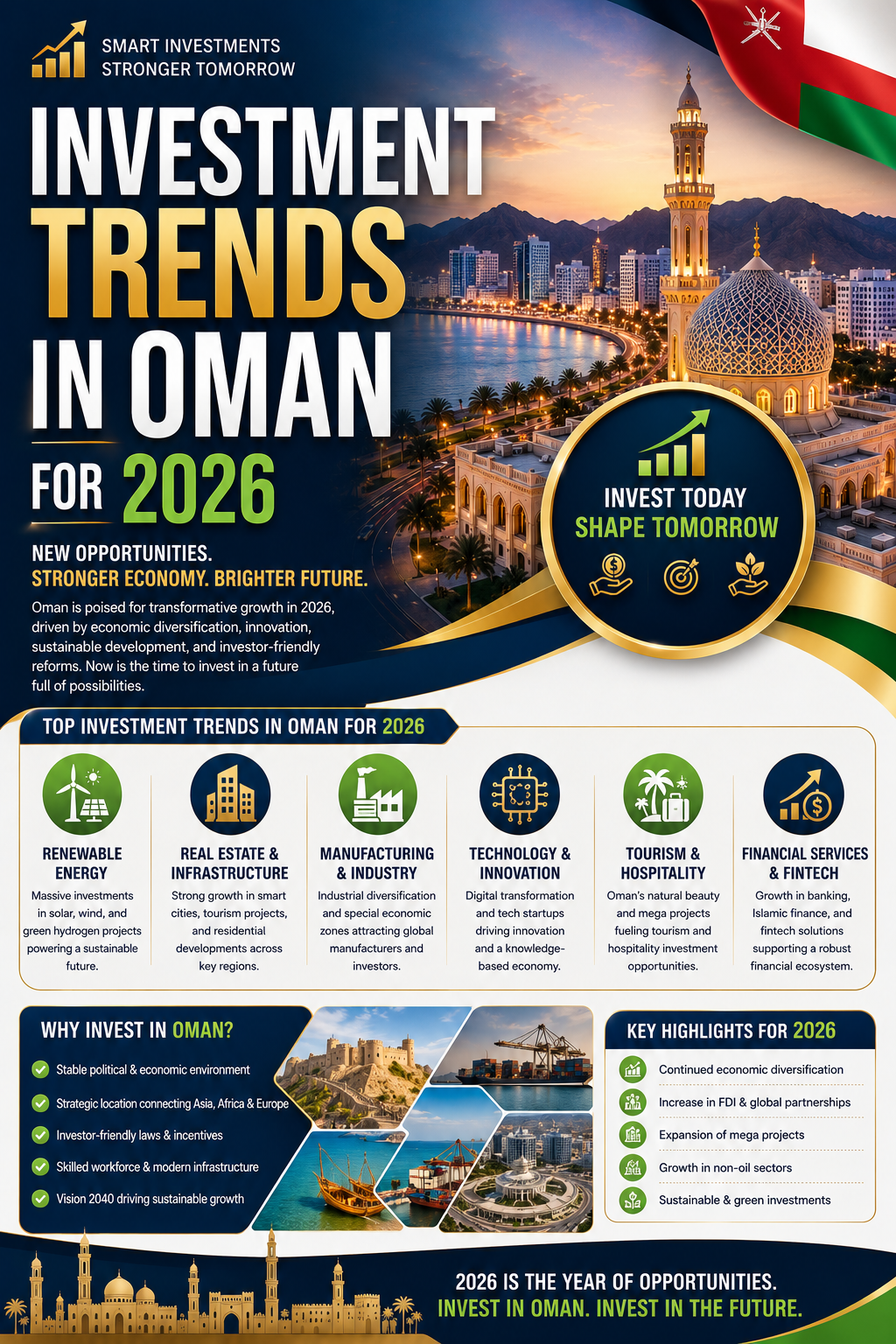
Quick Answer: Investment trends in Oman for 2026 are being shaped by economic diversification under Vision 2040, growth in renewable energy, logistics, tourism, technology, manufacturing, and real estate. Both local and foreign investors are increasingly focusing on sectors supported by government reforms, infrastructure development, and expanding private-sector participation.
Introduction
Oman is entering a new phase of economic transformation. While the country has long been recognized for its strategic location and energy resources, recent reforms are reshaping its investment landscape. Government initiatives, infrastructure development, and efforts to diversify the economy are creating opportunities across a broad range of industries.
For investors, this means the conversation is no longer limited to oil and gas. Renewable energy, logistics, tourism, digital technology, healthcare, manufacturing, and sustainable infrastructure are becoming increasingly important components of Oman’s growth story.
Whether you are a high-net-worth individual seeking portfolio diversification, an expatriate planning long-term financial security, or a foreign investor evaluating opportunities in the Gulf region, understanding these trends can help you make more informed investment decisions.
This guide explores the key investment trends expected to define Oman in 2026, explains the forces driving economic growth, and highlights practical considerations for investors looking to participate in the country’s evolving economy.
Executive Summary
Key Takeaways
- Oman continues to diversify its economy under Vision 2040.
- Renewable energy, particularly green hydrogen, is emerging as a major investment theme.
- Logistics and port infrastructure remain strategic growth areas.
- Tourism is expanding through large-scale hospitality and cultural projects.
- Technology and fintech are attracting increased investment.
- Manufacturing and industrial development continue to benefit from special economic zones.
- Real estate opportunities remain attractive in selected residential, commercial, and mixed-use segments.
- Foreign investment policies and business reforms are improving market accessibility.
- Diversification and long-term planning remain essential for successful investing.
Why Oman Is Attracting Investors in 2026
Several structural factors are contributing to growing investor confidence.
1. Vision 2040 Is Driving Economic Diversification
Oman’s Vision 2040 provides a long-term framework for reducing dependence on oil revenues and promoting sustainable economic growth.
The strategy encourages investment across sectors including:
- Renewable energy
- Logistics
- Tourism
- Manufacturing
- Fisheries
- Technology
- Healthcare
- Education
- Mining
- Financial services
For investors, this diversification reduces reliance on a single industry and opens access to a broader range of opportunities.
2. Strategic Geographic Location
Situated at the crossroads of Asia, Africa, and Europe, Oman benefits from direct access to major international shipping routes.
Its ports—including Sohar, Duqm, and Salalah—support international trade and position the country as a logistics hub for the Gulf region.
As global supply chains continue to evolve, investments in transportation, warehousing, and industrial infrastructure are expected to remain significant.
3. Business-Friendly Reforms
Oman has introduced a range of reforms designed to encourage domestic and foreign investment.
These include:
- Streamlined business registration processes
- Expanded opportunities for foreign ownership in selected sectors
- Investment incentives in special economic zones
- Public-private partnership initiatives
- Digital government services
Such reforms improve the ease of doing business and increase confidence among international investors.
4. Stable Financial Environment
While all investments carry risk, investors generally value predictable regulatory environments and prudent economic management.
Oman’s financial system continues to evolve through:
- Strengthened regulatory oversight
- Development of capital markets
- Expansion of Islamic finance
- Improved financial technology infrastructure
This provides a supportive environment for long-term investment planning.
Economic Outlook for 2026
Oman’s economic outlook is increasingly tied to diversification rather than commodity prices alone.
Several themes are expected to influence investment activity:
Infrastructure Expansion
Ongoing investments in transportation, ports, utilities, and industrial zones create opportunities across construction, logistics, engineering, and supporting services.
Private Sector Growth
Government policy increasingly encourages private-sector participation in economic development.
This creates opportunities in:
- Professional services
- Technology
- Manufacturing
- Healthcare
- Education
- Retail
- Hospitality
Digital Transformation
Businesses across Oman are adopting digital technologies to improve efficiency and customer experience.
Areas attracting investment include:
- Cloud computing
- Artificial intelligence
- Cybersecurity
- Digital payments
- E-commerce
- Smart city solutions
Digital transformation is expected to remain one of the country’s fastest-growing investment themes.
Sustainability
Environmental sustainability has become an important driver of investment decisions worldwide.
In Oman, investments linked to clean energy, efficient infrastructure, and resource management are expected to receive increasing attention from both public and private investors.
Top Investment Trends in Oman for 2026
1. Renewable Energy and Green Hydrogen
Perhaps the most significant long-term investment trend is the expansion of renewable energy.
Oman has significant natural advantages for renewable energy production, including abundant solar and wind resources.
Why This Sector Matters
Global demand for cleaner energy continues to grow.
Governments and businesses worldwide are investing heavily in technologies that reduce carbon emissions and improve energy security.
Oman is positioning itself as a regional leader in green hydrogen production, supported by large-scale renewable energy projects and strategic partnerships.
Opportunities for Investors
Potential areas include:
- Renewable energy infrastructure
- Green hydrogen projects
- Solar energy development
- Wind power generation
- Energy storage technologies
- Supporting industrial services
Potential Benefits
- Long-term growth potential
- Government support
- Increasing international demand
- Alignment with sustainability objectives
2. Logistics and Supply Chain Infrastructure
Logistics remains one of Oman’s strongest competitive advantages.
Major ports and transportation corridors connect regional and international markets.
Growth Drivers
- Expansion of free zones
- Increased international trade
- Industrial development
- E-commerce growth
- Regional distribution networks
Investment Opportunities
Investors may consider exposure to:
- Warehousing
- Distribution centers
- Port services
- Freight companies
- Industrial real estate
- Transportation technology
3. Tourism and Hospitality
Tourism continues to be a priority sector within Vision 2040.
Oman’s natural landscapes, cultural heritage, and expanding hospitality infrastructure support long-term growth prospects.
Areas Experiencing Growth
- Luxury hotels
- Eco-tourism
- Adventure tourism
- Cultural attractions
- Conference facilities
- Coastal developments
Why Investors Are Interested
Tourism often stimulates investment across multiple industries, including retail, transportation, food services, and real estate.
4. Technology and FinTech
Technology is rapidly becoming one of Oman’s most dynamic investment sectors.
Businesses increasingly rely on digital platforms to improve productivity, reduce costs, and deliver better customer experiences.
Fast-Growing Areas
- Artificial intelligence
- Financial technology
- Cybersecurity
- Cloud services
- Business software
- Digital banking
- Automation
Technology investments often complement broader economic modernization efforts.
5. Manufacturing and Industrial Development
Manufacturing remains an important pillar of Oman’s diversification strategy.
Special economic zones and industrial cities continue to attract investment in value-added industries.
Key Growth Areas
- Food processing
- Chemicals
- Construction materials
- Pharmaceuticals
- Advanced manufacturing
- Consumer goods
Manufacturing benefits from improving logistics infrastructure and access to regional export markets.
6. Real Estate
Real estate continues to play an important role in diversified investment portfolios.
Rather than viewing the sector as a single market, investors increasingly focus on specific property segments.
Residential
Demand remains linked to population growth, urban development, and housing preferences.
Commercial
Office space, retail developments, and mixed-use projects continue to evolve alongside business expansion.
Industrial
Industrial properties, warehouses, and logistics facilities are gaining importance as trade and manufacturing activity expand.
Hospitality
Hotels and serviced apartments benefit from tourism growth and business travel.
Featured Snippet: What Are the Top Investment Trends in Oman for 2026?
The leading investment trends in Oman for 2026 include:
- Renewable energy and green hydrogen
- Logistics and port infrastructure
- Tourism and hospitality
- Technology and fintech
- Manufacturing and industrial development
- Real estate
- Healthcare innovation
- Education and skills development
- Food security and agriculture
- Capital markets and diversified financial services
These sectors align closely with Oman’s Vision 2040 strategy and reflect the country’s long-term economic transformation.
Featured Snippet: Is Oman a Good Place to Invest in 2026?
Oman offers investors a combination of strategic location, ongoing economic diversification, supportive reforms, and investment opportunities across multiple sectors. While every investment involves risk, the country’s focus on infrastructure, renewable energy, logistics, tourism, and technology has broadened the range of opportunities available to local and international investors.
7. Healthcare and Life Sciences
Healthcare continues to be one of Oman’s most promising long-term investment sectors. Population growth, an aging demographic, and increasing demand for high-quality healthcare services are driving both public and private investment.
In addition to hospitals and clinics, opportunities are expanding in:
- Specialized medical centers
- Telemedicine platforms
- Medical technology
- Diagnostic laboratories
- Pharmaceutical manufacturing
- Health insurance services
- Elderly care facilities
Why Healthcare Is Attractive
Healthcare is often considered a defensive investment because demand for medical services remains relatively stable regardless of economic cycles.
For long-term investors, healthcare offers the potential for steady growth supported by ongoing demographic and technological trends.
8. Education and Skills Development
A skilled workforce is essential for achieving the goals of Oman Vision 2040.
As industries evolve, demand for education and workforce training continues to increase.
Areas of Opportunity
Investment opportunities include:
- Private schools
- International education providers
- Vocational training
- Professional certification programs
- Online learning platforms
- Corporate training services
- Educational technology (EdTech)
Investors interested in long-term human capital development may find education to be an attractive sector with sustained demand.
9. Food Security and Agriculture
Food security has become an increasingly important priority across the Gulf region.
Oman is investing in technologies and infrastructure designed to improve domestic food production and supply chain resilience.
Emerging Opportunities
- Smart farming
- Greenhouse agriculture
- Aquaculture
- Food processing
- Agricultural technology
- Cold storage facilities
- Food logistics
Global trends such as climate change and supply chain disruptions have increased interest in resilient food systems, making this sector more relevant for long-term investment.
10. Capital Markets and Financial Services
Oman’s financial markets continue to develop, providing investors with broader access to investment products and professional financial services.
Areas of growth include:
- Equity markets
- Corporate bonds
- Sukuk (Islamic bonds)
- Mutual funds
- Exchange-Traded Funds (ETFs)
- Wealth management
- Private banking
- Asset management
- Financial advisory services
The continued evolution of the financial sector supports greater participation from both domestic and international investors.
Best Investment Opportunities by Investor Type
Different investor profiles require different strategies. Understanding your objectives can help you prioritize suitable sectors and investment approaches.
High-Net-Worth Individuals (HNWIs)
High-net-worth investors often seek a balance between capital preservation, growth, and legacy planning.
Suitable opportunities may include:
- Private wealth management
- Commercial real estate
- Private equity
- Infrastructure projects
- Global diversified portfolios
- Family office services
Key Priorities
- Long-term wealth preservation
- Diversification
- Risk-adjusted returns
- Succession planning
Expatriates Living in Oman
Expatriates often have unique financial goals, such as building retirement savings while maintaining flexibility across international markets.
Potential investment areas include:
- Globally diversified investment funds
- Exchange-Traded Funds (ETFs)
- Retirement planning solutions
- Real estate (subject to applicable regulations)
- International equities
- Balanced investment portfolios
Considerations
- Currency exposure
- Long-term financial planning
- Cross-border investment needs
- Tax implications in the investor’s home country
Foreign Investors
Foreign investors are increasingly attracted to Oman’s strategic location and economic diversification.
Key sectors include:
- Renewable energy
- Manufacturing
- Logistics
- Tourism
- Technology
- Infrastructure
- Industrial development
What Matters Most
- Understanding the regulatory environment
- Evaluating market demand
- Assessing political and economic stability
- Working with experienced local advisors
Entrepreneurs
Entrepreneurs may benefit from investing in industries aligned with economic modernization.
Examples include:
- Technology startups
- Digital services
- Green technologies
- Hospitality ventures
- Professional services
- Manufacturing businesses
Institutional Investors
Institutional investors generally focus on larger-scale opportunities such as:
- Infrastructure
- Renewable energy
- Logistics
- Industrial parks
- Private equity
- Real estate investment funds
These investments often involve longer investment horizons and detailed due diligence.
Comparison Table: Investment Sectors in Oman
| Sector | Growth Potential | Risk Level | Typical Investment Horizon | Suitable Investor |
|---|---|---|---|---|
| Renewable Energy | High | Medium | Long-term | HNWIs, Institutional, Foreign Investors |
| Logistics | High | Medium | Long-term | Business Owners, Institutional |
| Tourism | Medium–High | Medium | Medium to Long-term | Entrepreneurs, Private Investors |
| Real Estate | Medium | Medium | Long-term | HNWIs, Expatriates |
| Technology | High | High | Long-term | Growth Investors |
| Manufacturing | Medium–High | Medium | Long-term | Business Investors |
| Healthcare | Medium | Low–Medium | Long-term | Conservative Investors |
| Education | Medium | Low–Medium | Long-term | Long-term Investors |
| Agriculture & Food Security | Medium | Medium | Long-term | Diversified Investors |
| Capital Markets | Variable | Medium | Flexible | Most Investor Types |
Building a Diversified Investment Strategy
A successful investment strategy rarely depends on a single asset or sector.
Instead, experienced investors typically spread capital across multiple investments to reduce concentration risk.
A diversified portfolio might include:
- Listed equities
- Fixed-income investments
- Real estate
- Infrastructure exposure
- International investments
- Cash or cash equivalents
- Alternative investments
Diversification does not eliminate risk, but it can help reduce the impact of poor performance in any one investment.
Understanding Investment Risks
Every investment involves some level of uncertainty.
Being aware of potential risks is essential for making informed decisions.
Market Risk
Changes in market conditions may affect the value of investments.
Inflation Risk
Inflation reduces purchasing power over time, making it important for investments to generate returns that outpace rising prices.
Interest Rate Risk
Interest rate movements can affect borrowing costs, bond prices, and investment valuations.
Currency Risk
International investors should consider fluctuations in exchange rates when investing across different currencies.
Regulatory Risk
Changes in laws or regulations can influence investment outcomes, particularly in emerging industries.
Liquidity Risk
Certain investments may be difficult to sell quickly without affecting their market value.
Common Mistakes Investors Make
Investing Without Clear Goals
Every investment decision should support a defined financial objective.
Following Market Hype
Popular trends do not always lead to sustainable long-term returns.
Careful research remains essential.
Ignoring Diversification
Concentrating investments in a single sector increases exposure to sector-specific risks.
Overlooking Costs
Management fees, transaction costs, and other expenses can significantly affect long-term returns.
Making Emotional Decisions
Reacting impulsively to short-term market fluctuations often undermines long-term investment success.
Expert Tips for Investing in Oman
Think Long-Term
Economic transformation takes time. Investors with longer horizons are often better positioned to benefit from structural growth.
Understand the Sector
Before investing, study industry fundamentals rather than relying solely on headlines or market sentiment.
Review Your Portfolio Regularly
Financial goals and market conditions evolve over time. Periodic reviews help ensure your portfolio remains aligned with your objectives.
Balance Risk and Opportunity
High-growth sectors can offer attractive returns, but they may also involve greater volatility.
Seek Professional Advice
For complex financial situations, working with qualified investment professionals can help improve decision-making and portfolio management.
Case Study 1: High-Net-Worth Investor
Profile: Business owner seeking long-term capital preservation and growth.
Approach: A diversified portfolio combining commercial real estate, global equities, infrastructure exposure, and fixed-income investments.
Outcome: Reduced concentration risk while maintaining exposure to multiple growth sectors.
Case Study 2: Expatriate Professional
Profile: Mid-career expatriate planning for retirement.
Approach: Monthly investments into globally diversified funds combined with periodic portfolio reviews.
Outcome: A disciplined strategy focused on long-term wealth accumulation rather than short-term market timing.
Case Study 3: Foreign Investor
Profile: Investor exploring opportunities linked to Oman’s economic diversification.
Approach: Exposure to renewable energy, logistics, and industrial development through a diversified investment portfolio.
Outcome: Participation in sectors aligned with long-term national development priorities while maintaining diversification.
Investor Checklist
Before making an investment, ask yourself:
- What are my financial goals?
- What is my investment horizon?
- How much risk am I comfortably able to accept?
- Is my portfolio diversified?
- Have I researched the sector?
- Do I understand all associated costs?
- Have I considered potential risks?
- Does this investment align with my long-term strategy?
- Do I need professional financial advice?
- Have I reviewed my investment plan recently?
Conclusion
Oman’s investment landscape in 2026 reflects an economy that is steadily broadening its foundations beyond traditional sectors. Growth in renewable energy, logistics, tourism, technology, healthcare, manufacturing, and financial services demonstrates the country’s commitment to long-term economic diversification.
For investors, the key opportunity lies not in chasing short-term trends but in understanding how these structural developments fit into a broader investment strategy. Building a diversified portfolio, evaluating risks carefully, and aligning investments with personal financial goals remain essential practices regardless of market conditions.
Whether you are a high-net-worth individual, an expatriate, or a foreign investor, Oman offers a range of opportunities across established and emerging industries. Taking a disciplined, research-driven approach—and seeking professional advice when appropriate—can help you navigate these opportunities with greater confidence.
Call to Action
Looking to stay ahead of Oman’s evolving investment landscape?
Explore more expert guides on Gutit.online covering investment opportunities, wealth management, real estate, capital markets, and sector-specific insights. By combining reliable information with a long-term perspective, you can make more informed decisions as Oman continues its economic transformation.