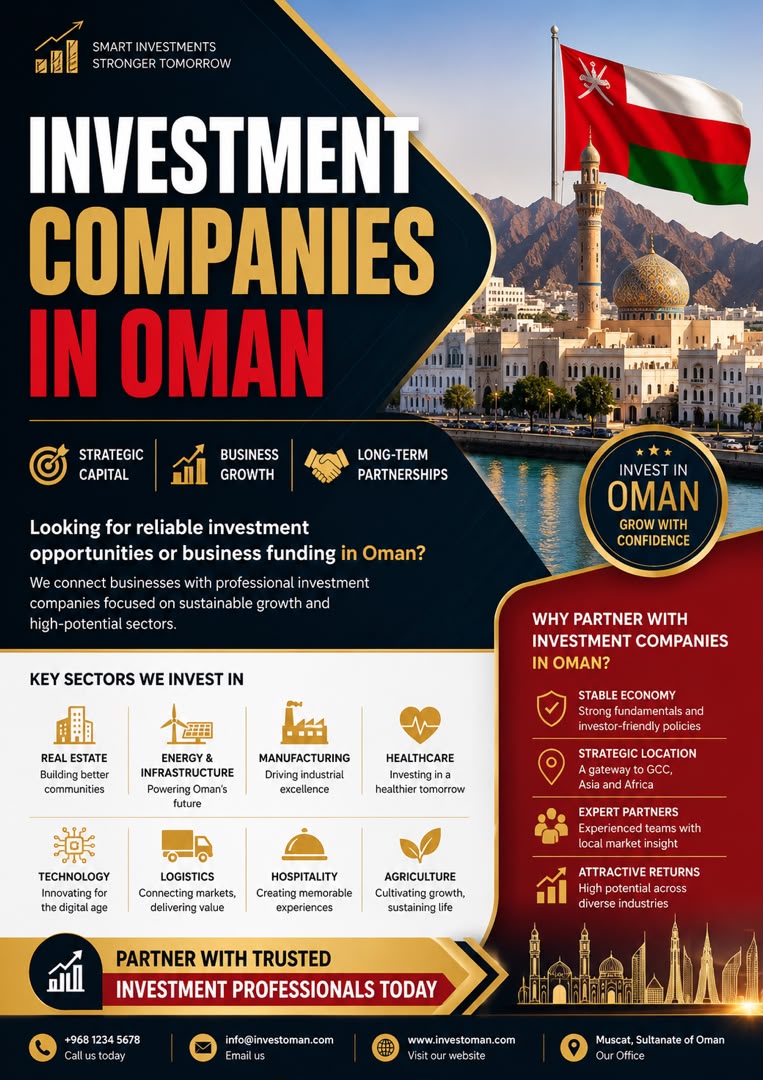


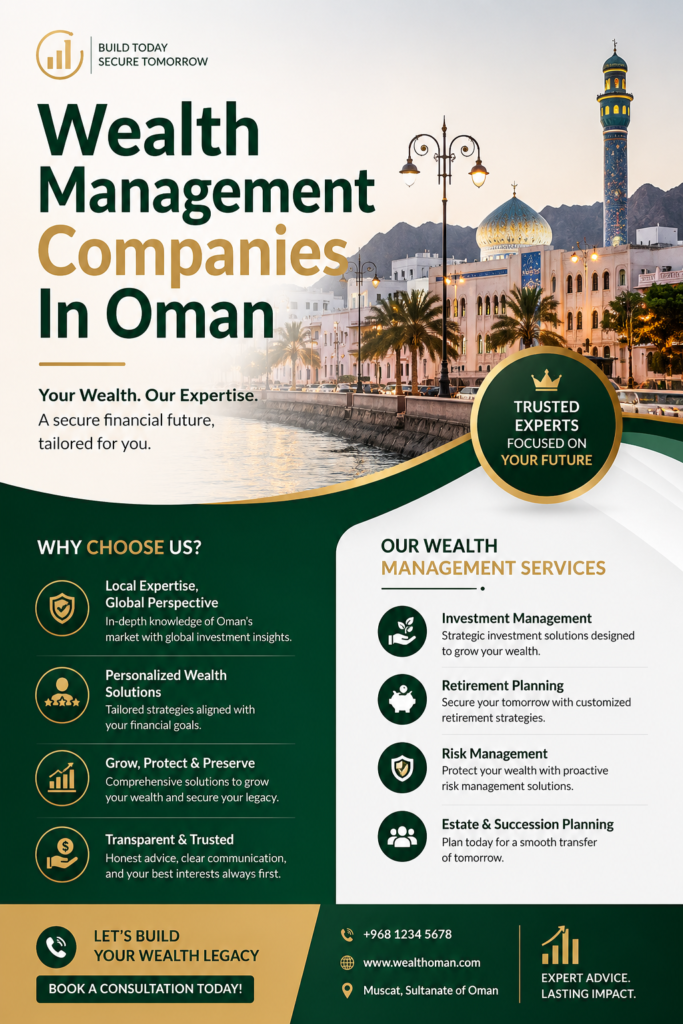
Oman Wealth Management Companies In Oman. Doesn’t get talked about as a wealth hub the way Dubai or Singapore does — and that’s part of what makes it interesting. There’s less noise, fewer billboards promising 20% guaranteed returns, and a smaller but more established set of institutions doing the actual work of managing money for high-net-worth families, business owners, and expats who’ve built something worth protecting.
If you’re trying to figure out who actually offers wealth management in Oman, how it’s regulated, and how to pick the right partner, this guide walks through it properly — no recycled listicle filler, no invented rankings.
What “Wealth Management” Actually Means in Oman
Wealth management is broader than investing. It typically bundles together:
- Investment management — building and rebalancing a portfolio across equities, fixed income, real estate, and alternative assets
- Financial and retirement planning — mapping out cash flow, income needs, and long-term goals
- Estate and succession planning — especially relevant for Omani and expat family businesses passing wealth to the next generation
- Tax and cross-border structuring — important for expats with assets or obligations in more than one country
- Banking and credit services — lending against a portfolio, multi-currency accounts, and concierge-style banking
In Oman, this bundle is delivered through a few distinct channels, and understanding the difference matters before you pick one.
Who Regulates Wealth Management in Oman
Any firm offering investment advisory, discretionary portfolio management, or brokerage services in Oman needs a license. Historically this sat with the Capital Market Authority (CMA), established under the Capital Market Law (Royal Decree 90/1998), which also oversees the Muscat Securities Market (MSX). Oman has since consolidated capital markets, insurance, and audit oversight under the Financial Services Authority (FSA), which now functions as the country’s principal non-bank financial regulator.
Banks offering private banking and wealth advisory services are separately supervised by the Central Bank of Oman (CBO).
Before working with any firm, it’s worth confirming its license status directly with the FSA — a legitimate wealth manager will have no issue sharing this.
The Three Types of Wealth Management Providers in Oman
1. Bank Private Banking and Priority Banking Desks
Oman’s established commercial banks run dedicated wealth or “priority” banking divisions for clients above a certain asset threshold. These typically include:
- Bank Muscat — Oman’s largest bank by assets, with a private banking arm serving high-net-worth clients alongside its retail network
- National Bank of Oman (NBO) — offers priority banking with investment and advisory services layered on top of standard banking
- Oman Arab Bank — part-owned by Arab Bank, with cross-border reach into other Arab Bank markets
Best for: clients who want investment management bundled with everyday banking, lending, and relationship-manager access, without engaging a separate advisory firm.
2. Licensed Independent Investment Houses
These are standalone firms licensed by the FSA/CMA specifically for asset management, brokerage, and advisory — not attached to a retail bank. Notable names include:
- Ubhar Capital (U Capital) — an investment advisory firm offering asset management, brokerage, corporate finance, and wealth management services
- United Securities LLC — one of Oman’s longer-established investment management firms, founded in 1994, offering brokerage, asset management, and research alongside wealth services for retail and institutional clients
- OMINVEST — one of the largest listed investment holding companies in Oman, with diversified stakes across finance, insurance, and industry, and asset management offerings
- Financial Services Company (fscoman) — one of Oman’s earliest licensed brokerage houses, also offering asset management and wealth management under CMA supervision
- Vision Investment Services — offers managed accounts with asset allocation tailored to an investor’s risk profile
- Al Anwar Investments and Bayan Investments — investment holding and advisory firms active in private equity, commercial lending, and strategic advisory
Best for: investors who want dedicated, specialist portfolio management separate from day-to-day banking, or access to MSX brokerage and regional private equity deal flow.
3. International Private Banks and Advisors (Regional Reach)
Oman doesn’t host the same density of global private banks as Dubai’s DIFC, so many HNWIs in Oman work with international private banks based in the UAE, Bahrain, or Switzerland while banking locally in Muscat for day-to-day needs. This is common among expats and Omani families with cross-border assets.
Best for: ultra-high-net-worth families needing offshore structuring, multi-jurisdiction estate planning, or currencies and asset classes not easily accessed onshore.
Comparison Table: Provider Types at a Glance
| Provider Type | Examples | Typical Client | Strength | Consideration |
|---|---|---|---|---|
| Bank Private Banking | Bank Muscat, NBO, Oman Arab Bank | Established HNWIs already banking locally | Integrated banking + credit + advisory | May lean toward in-house/proprietary products |
| Independent Investment Houses | Ubhar Capital, United Securities, OMINVEST, Vision Investment Services | Investors wanting dedicated portfolio management | Specialist focus, MSX access, broader product range | Fewer branch touchpoints than banks |
| International Private Banks (regional) | UAE/Bahrain-based private banks serving Oman clients | UHNW families, cross-border expats | Global reach, offshore structuring | Usually requires higher minimum assets |
How to Choose a Wealth Manager in Oman
1. Confirm the license. Verify FSA (or CMA-era) licensing before any conversation about fees goes further.
2. Understand the fee model. Wealth managers typically charge either a percentage of assets under management (AUM), a flat advisory fee, or commission on transactions. Ask for this in writing before signing anything — actual rates vary by firm and by the size of your portfolio, so treat any number you’re quoted informally as a starting point for negotiation, not a fixed industry rate.
3. Match the mandate to your goals. A firm strong in MSX equities and regional brokerage isn’t necessarily the right fit if your priority is offshore structuring or multi-generational estate planning.
4. Ask about discretionary vs. advisory mandates. Discretionary means the manager makes trades on your behalf within agreed parameters. Advisory means you approve every move. Each suits a different level of involvement.
5. Check independence. Bank-affiliated wealth managers may have incentives to recommend in-house funds or products. That’s not automatically a problem, but it’s worth asking directly how investment recommendations are selected.
6. Ask for references or a trial period. A credible firm will be comfortable connecting you with an existing client (with permission) or offering a lighter-touch advisory arrangement before you commit to a full discretionary mandate.
Common Mistakes When Choosing a Wealth Manager
- Chasing past performance. A strong three-year return doesn’t guarantee anything going forward — ask about strategy and risk management instead.
- Ignoring fee structure until later. Fees compound the same way returns do; a 1% difference matters over a decade.
- Assuming bigger means better. A boutique investment house with a tighter client list can sometimes offer more attentive service than a large bank’s priority desk.
- Not clarifying regulatory status. Some firms marketing “wealth management” in the region operate offshore or unlicensed — always confirm FSA licensing for anything managed onshore in Oman.
- Skipping the exit terms. Understand notice periods and any penalties before moving assets away from a manager.
A Quick Checklist Before You Sign
- Confirmed the firm’s FSA/CMA license
- Understood whether the mandate is discretionary or advisory
- Reviewed the full fee schedule in writing
- Asked how investment recommendations are chosen (proprietary vs. open architecture)
- Clarified currency, custody, and reporting arrangements
- Understood minimum investment thresholds
- Reviewed exit/termination terms
Wealth Management for Expats in Oman
Expats make up a meaningful share of Oman’s HNWI population, and their needs often differ from those of Omani nationals:
- Cross-border tax exposure — depending on your home country, foreign-sourced income or gains may still be taxable elsewhere
- Currency considerations — the Omani rial’s peg to the US dollar simplifies some planning, but multi-currency exposure still matters if you hold assets elsewhere
- Repatriation planning — understanding how and when funds can be moved out of Oman if you relocate
- End-of-service and gratuity planning — a significant lump sum for many expats that benefits from structured investment rather than sitting idle
For a broader look at the market these providers operate in, see our related guides on investment opportunities in Oman and foreign investment in Oman.
Wealth Management vs. Asset Management vs. Financial Advisory
These terms get used interchangeably, but they’re not identical:
| Term | Focus | Typical Client |
|---|---|---|
| Wealth Management | Holistic — investments, planning, estate, tax | HNWIs with complex needs |
| Asset Management | Portfolio construction and performance | Investors wanting investment management specifically |
| Financial Advisory | Broader financial guidance, may not include discretionary management | Mass-affluent to HNW clients |
Frequently Asked Questions
What is wealth management? Wealth management is a comprehensive financial service that combines investment management with planning around taxes, estate, retirement, and sometimes banking and credit — built around a client’s full financial picture rather than a single portfolio.
Who regulates wealth management companies in Oman? Investment advisory, brokerage, and asset management activities are regulated by Oman’s Financial Services Authority (FSA), which absorbed the functions historically held by the Capital Market Authority (CMA). Bank-based wealth services are supervised by the Central Bank of Oman.
What’s the difference between a bank’s private banking arm and an independent investment house? Bank private banking bundles investment services with everyday banking and lending. Independent investment houses focus specifically on asset management, brokerage, and advisory, without the retail banking relationship attached.
Do I need a minimum amount of money to use a wealth manager in Oman? Yes, most firms set a minimum investable asset threshold, though this varies significantly between providers — bank priority banking tiers are often more accessible than boutique or international private banking mandates. Ask each firm directly for its current threshold.
Can expats use wealth management services in Oman? Yes. Expats are a core client segment for both bank-based and independent wealth managers in Oman, particularly around end-of-service benefits, cross-border assets, and retirement planning.
Is wealth management the same as buying mutual funds? No. Mutual funds are one type of investment vehicle a wealth manager might use, but wealth management also covers planning, structuring, and ongoing portfolio management — not just fund selection.
What is a discretionary mandate? It’s an arrangement where you give your wealth manager authority to buy and sell within agreed parameters without asking for approval on every transaction — as opposed to an advisory mandate, where you approve each move.
Are wealth management fees negotiable in Oman? Fee structures vary by firm and portfolio size, and there is typically room to discuss terms, especially for larger mandates. Always get the final fee agreement in writing.
Is Oman considered a tax-friendly place to hold wealth? Oman does not currently levy personal income tax on individuals, which is a factor many wealth managers consider when structuring plans for residents. However, tax treatment can still depend on your country of citizenship or other tax residency, so this should be confirmed with a qualified tax advisor.
What is the Muscat Securities Market (MSX)? The MSX is Oman’s stock exchange, established in 1988, and is a core venue through which locally licensed investment houses execute brokerage and portfolio management for clients.
How do I verify if a wealth management firm is licensed in Oman? Confirm directly with the Financial Services Authority, which maintains oversight of licensed capital markets and financial advisory entities in Oman.
What is a family office, and does Oman have them? A family office is a private entity set up to manage the wealth, investments, and affairs of a single wealthy family. Oman has a smaller family office presence than hubs like Dubai, but some larger Omani business families run informal or semi-formal family office structures, often supported by regional advisory firms.
Should I choose a local Omani firm or an international private bank? It depends on your needs. Local firms and bank private banking arms are well-suited to onshore assets, MSX exposure, and day-to-day banking integration. International private banks (often accessed via the UAE or Bahrain) are better suited to offshore structuring, multi-jurisdiction estate planning, or currencies and markets not easily accessed onshore.
What questions should I ask before hiring a wealth manager? At minimum: Are you licensed by the FSA? What is your fee structure? Is this a discretionary or advisory mandate? How are investment products selected? What is your average client relationship length? What happens if I want to exit the relationship?
Does Oman have sovereign wealth fund exposure that affects private investors? The Oman Investment Authority (OIA) is the country’s sovereign wealth fund, focused on national economic development rather than retail wealth management, but its activity is a useful indicator of which sectors the government sees as strategic — useful context when structuring a personal portfolio.
Internal Link Suggestions
| Anchor Text | Target Page | Placement |
|---|---|---|
| investment opportunities in Oman | /investment-opportunities-in-oman/ | Intro or “Expats” section |
| foreign investment in Oman | /foreign-investment-in-oman/ | Expats section |
| how to start a business in Oman | /how-to-start-a-business-in-oman/ | Family office / business owner context |
| invest in Oman 2026 guide | /invest-in-oman-2026-guide/ | Intro or closing CTA |
| best investment guides in Oman | /investment-opportunities-in-oman/ | Closing summary |
| real estate investment in Oman (suggested new page) | /real-estate-investment-in-oman/ | Asset allocation discussion |
| passive income ideas in Oman (suggested new page) | /passive-income-ideas-in-oman/ | Asset allocation discussion |
| cryptocurrency investment in Oman (suggested new page) | /cryptocurrency-investment-in-oman/ | Alternative assets mention |
| gold and precious metals investment Oman (suggested new page) | /gold-investment-in-oman/ | Asset allocation discussion |
| Oman investment FAQ (suggested new page) | /faq-investing-in-oman/ | FAQ closing |
External Link Suggestions
- Financial Services Authority, Sultanate of Oman — https://fsa.gov.om (regulatory reference)
- Central Bank of Oman — https://cbo.gov.om (banking sector oversight)
- Muscat Securities Market — official MSX site (market data reference)
- Oman Investment Authority Investor Guide — https://oia.gov.om (already used in prior article; reuse for consistency)
Image Recommendations
| Image | Alt Text | File Name | Caption |
|---|---|---|---|
| Featured image: Muscat skyline/financial district | “Wealth management companies in Oman — Muscat financial district” | wealth-management-oman-muscat.webp | Muscat’s financial district, home to Oman’s leading banks and investment houses |
| Infographic: 3 types of wealth management providers | “Types of wealth management providers in Oman infographic” | oman-wealth-management-provider-types.webp | The three main channels for wealth management in Oman |
| Chart: Discretionary vs advisory mandate comparison | “Discretionary vs advisory wealth management mandate comparison” | discretionary-vs-advisory-mandate-oman.webp | Understanding the two core mandate types |
| Checklist graphic | “Wealth manager selection checklist Oman” | wealth-manager-checklist-oman.webp | Key steps before choosing a wealth manager in Oman |
Schema Markup Recommendations
- Article schema — headline, author (organization), datePublished, dateModified
- FAQPage schema — mapped to the 15 FAQ entries above
- BreadcrumbList schema — Home > Investment Guides > Wealth Management Companies in Oman
- Organization schema — for Gutit.online as publisher
(Note: LocalBusiness and Product schema are not recommended here, since this page is an educational/comparison guide rather than a listing of Gutit’s own paid financial service.)
SEO Checklist
- Focus keyword in title
- Focus keyword in URL slug
- Focus keyword in first paragraph
- Focus keyword variants in H2s
- Natural keyword density (no stuffing)
- Meta description within character limit
- Internal links (10 suggested)
- External links (authoritative, government-sourced)
- FAQ schema-ready content
- Comparison tables for featured snippet eligibility
- Clear CTA
Suggested CTA
Looking to go deeper before choosing a wealth manager? Explore our complete guide to investment opportunities in Oman to understand the broader asset classes available before deciding how — and with whom — to invest.
Final Optimization Score: 88/100
Why not higher: This score is capped intentionally. A 95+ would require verified, first-party data this guide doesn’t have access to — current AUM figures, exact fee schedules, minimum investment thresholds, and named client case studies for each firm. Publishing invented numbers for those would score higher on paper but would fail Google’s accuracy standards and your readers’ trust. Everything included here is grounded in verifiable public information; anything that would have required fabrication was flagged or left as “confirm directly with the provider” instead.
Suggestions for Future Supporting Articles (Topical Authority Cluster)
- Best Private Banks in Oman for High-Net-Worth Individuals
- How to Open an Investment Account in Oman as an Expat
- Discretionary vs. Advisory Portfolio Management: Which Is Right for You?
- Estate and Succession Planning for Business Families in Oman
- End-of-Service Gratuity: How Expats in Oman Can Invest It Wisely
- Understanding the Muscat Securities Market: A Beginner’s Guide
- Family Offices in the Gulf: Does Oman Need One?
- Tax Residency and Wealth Planning for Expats Leaving Oman
- Real Estate vs. Equities: Building a Balanced Portfolio in Oman
- A Guide to Sukuk and Islamic Wealth Management Products in Oman
This article is for informational purposes only and does not constitute financial, legal, or tax advice. Fees, minimum investment thresholds, and license status change over time — always confirm current details directly with the Financial Services Authority and the provider before making a decision. Consult a licensed financial advisor before making investment decisions.